Reality Is Suspicious and So Are You
This month, I tried to read books that, strictly speaking, weren’t about the world ending in fire, bureaucracy, or vibes. Not because I believe the world isn’t decomposing in full view — it is, and with remarkable enthusiasm — but because I am occasionally tired of being reminded.
I didn’t consume books like they were rations in a bunker. I didn’t read to survive. I read to live. And it was exactly what my overtaxed little brain needed. Books full of humor, weirdness, and sharp little elbows jabbing at the ribs of reality. Did the world behave better as a result? Nope. But these books at least did not add to the noise. They were entertaining. Intelligent. Occasionally infuriating.
You know. Worthwhile.
Can I connect them all thematically? Ha. Obviously. That’s what we do here. Let’s lay them out like tea leaves spilled across a summoning circle and see what dark magic swirls out.
If there’s a thread among these books, it’s not tone or genre. It’s attitude. These are books written by and for people who look at the world and say, “I don’t think so.” Books that side-eye the system, question reality, and refuse to take their elbows off the table.
They are books for people who suspect that reality (like most things) has been poorly edited, and that it’s entirely reasonable to rewrite it.
If you’re looking for polite stories about polite people doing what they’re told, you’ll find none of that here.
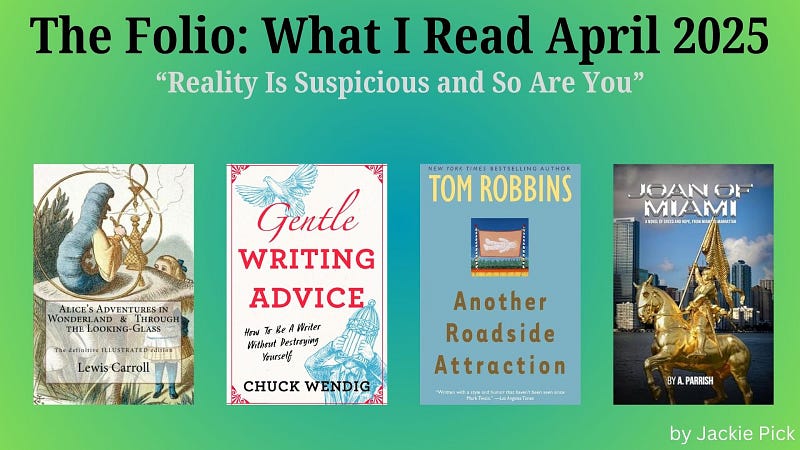
Which is all just to say these are the books I enjoyed enough to finish in the last month:
Alice In Wonderland/Through the Looking Glass by Lewis Carroll
Gentle Writing Advice by Chuck Wendig
Another Roadside Attraction by Tom Robbins
Joan of Miami by A. Parrish
Let’s begin.
Alice’s Adventures in Wonderland/Through the Looking Glass by Lewis Carroll
Abandon Linear Thought, Ye Mighty.
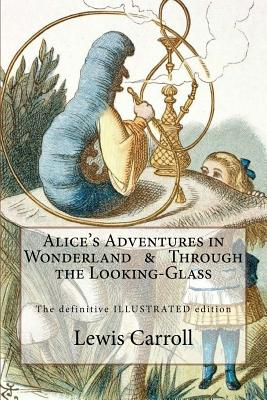
Lewis Carroll’s Alice’s Adventures in Wonderland and its companion novel, Through the Looking-Glass, form an enduringly strange and brilliant duology. These tales are far more than whimsical romps through fantastical lands — they are surrealist puzzles, philosophical playgrounds, and cultural mirrors that continue to enchant and perplex readers of all ages.
Though often lumped together, Alice’s Adventures in Wonderland and Through the Looking-Glass have distinct tones and structures. Both follow Alice, a sensible girl dropped into thoroughly nonsensical worlds: first through a rabbit hole into the chaotic dream-logic of Wonderland, then through a mirror into a more structured, chessboard-like realm. Wonderland is a tumbling disorder full of talking animals, shifting rules, and queens obsessed with beheadings, while Looking-Glass is more of a surreal thought experiment, populated by living poetry, mirrored rules, and unsettling nursery rhyme characters. If the first is all riddles and reversals, the second feels like an upward climb toward queenship, meaning, and a strange kind of self-awareness. Both show worlds run by folks who absolutely should not be running the world. Through it all, Alice is as polite as she can be.
Carroll’s characters are unforgettable weirdos who’ve pitched tents in the collective unconscious. From the fretful White Rabbit and the cryptic Cheshire Cat to the haughty Red Queen and the delightfully befuddled Tweedledee and Tweedledum, each figure feels both iconic and symbolic. Some represent the adult world’s hypocrisy, others embody logical paradoxes or childhood anxieties. Their nonsensical dialogue is often razor-sharp satire disguised as silliness. They are real in that sideways way. They’re not metaphors, they are archetypes of dysfunction. And Alice, when she doesn’t outright defeat them, walks away.
Though often labeled children’s stories, these books are subversive and complex. Carroll’s background as a mathematician shines through in his love of paradox and his relentless wordplay as the engine of the narrative. Logic, grammar, and social norms are constantly upended. Alice isn’t just navigating strange places; she’s navigating meaning itself. The poems, puns, and riddles twist language until it starts to resemble something closer to truth — or at least, a more honest kind of nonsense. Carroll games the English language like an old pinball machine and never tilts.
And it works because Carroll seems to understand better than most that language is a power tool. Or a tool of power. Either way, people in power often speak the most nonsense with the greatest confidence.
Alice is a triumphant protagonist: curious, skeptical, occasionally indignant, and deeply grounded in a child’s sense of fairness and reason. She’s not a wide-eyed innocent but a sharp observer who meets absurdity with exasperation rather than awe, making her the voice of reason in a world that gleefully resists it. Neither helpless nor perfect, she holds her own against the madness. In doing so, she becomes the grounding force that allows the books to spiral, twist, and tumble without losing their center.
Alice is just trying to make sense of it all, get to where she thinks she should go, and make some friends along the way without getting her head bitten (or chopped) off.
Aren’t we all?
These books endure because they resist a single interpretation. They can be read as nonsense or satire, fantasy or dreamscape, children’s story or commentary on Victorian society — or all of these at once. Carroll invites readers into a world where nothing is fixed, and that openness keeps Alice fresh with each reread.
Together, Alice’s Adventures in Wonderland and Through the Looking-Glass are strange, clever, disorienting, and absolutely iconic for reasons that are both obvious and, frankly, impossible to explain. They remind us that logic can be silly, that childhood contains profound insight, and that language itself is a kind of magic.
If you’re willing to wander, they’ll take you somewhere worth going.
Gentle Writing Advice by Chuck Wendig
How to Be a Writer Without Coming Entirely Unglued

Writing advice is usually:
- Agonizingly Practical (“Use a timer, a color-coded scene-by-scene spreadsheet, and an accountability partner with a whistle and cocked eyebrow.”)
- Fussily Prescriptive (“Make sure your protagonist’s internal arc adheres to all twelve stages of the Hero’s Journey and Save the Cat, then read the entire Western Canon [preferably in the original languages] before attempting dialogue.”)
- Completely Bananas (“Lie in damp grass, arch your feet, and listen for the ghost of Virginia Woolf to whisper your story into the mist.”)
Oh ho! But there’s another category: advice that isn’t so much instruction as permission. Permission to be weird. Permission to be lost. Permission to not write for a while, or write badly, or want to burn everything down and start a goat farm.
This category is usually where the good stuff is.
Cue Chuck Wendig.
Gentle Writing Advice: How to Be a Writer Without Destroying Yourself is, in theory, a craft book. But in reality, it’s an exploration of “Why Bother?” in the best sense. It’s also hysterical, intelligent, and surprisingly tender in a way that makes you realize halfway through a solid joke about Comic Sans that you’re actually crying. Or writing your next book. Or both.
I am a — well, not firm believer, but a somewhat jiggly, Jell-O-level believer — that writing expertise is mostly a slippery reflection of what we’ve already done. For example, I am an expert on my most recent dumb social media joke, my last published piece, and my last writing disaster (unpublished, thank goodness). That’s the résumé. And yet, like everyone else, I want the hacks. The tricks. The hacks about the tricks.
But what we really want is reassurance that we’re capable, we’ll find our voice (again or ever), and our messiness doesn’t disqualify us from making something good. We want to laugh at ourselves and fiercely believe in ourselves. We want someone to tell us how to be confident and vulnerable and brave and realistic and gentle and productive and very specifically address the spiral of concerns we have about that one unfinished essay that haunts us like a ghost in a hoodie sitting in the corner of our writing space playing the recorder.
Chuck Wendig gets that. (The need-for-reassurance part, not the recorder-playing-ghost part. I hope.)
Note: Yes, the title says “gentle,” but he’s saucy and foul-mouthed, and his words come at you rat-a-tat-tat. And then, like most saucy, hilarious, foul-mouthed people, he lets the mushy, empathetic core out.
In the introduction, Wendig warns us: “Writing advice is bullshit. But bullshit fertilizes.”
Unfortunately, this is very good advice.
He takes aim at the MFA-ified “listen to the clouds” advice that dominates traditional literary circles. Not because it’s wrong, but because it doesn’t always speak to the chaos-writing many of us do in the margins of our lives. We, the 4 AM Scribblers.
Please consider this book if only for the footnotes. (See page 8 for one that made me snort my coffee). Chapter 5, “Self-Care for Writers,” contains a section on shame that I desperately needed, along with perhaps one of the most resonant pieces of writing advice I’ve ever heard:
“Self-care sometimes means limiting people’s access to you.”
This funny, sweary, generous writing guide believes in you. It’s vulnerable because it knows you are, too. It’s strong because it’s built to help you keep going. Gentle Writing Advice connects us to something inside ourselves that still believes in trying.
And honestly? I’m happy Wendig and I live in the same timeline. (I think. The man gives strong “slides between dimensions on Tuesdays” energy.)
Another Roadside Attraction by Tom Robbins
Absurdist fiction / countercultural theology / metaphysical hot dog stand

Let me begin by saying that I do not believe in roadside attractions. I believe in roads. I believe in destinations. I believe in stopping only when absolutely necessary: for example, when a building is on fire, or when someone is waving at you to prevent you from driving into a sinkhole.
Roadside attractions, as a concept, suggest you are not already where you’re meant to be.
Which also describes this novel.
Another Roadside Attraction is Tom Robbins’s debut novel, and it comes in HOT. The plot, such as it is, is something like: a clairvoyant ex-circus performer named Amanda and her musician/tightrope-walking husband John Paul open a roadside hot dog stand that is also a museum of weirdness. They are joined by a scientist/drifter/occasional scold named Marx Marvelous and an ex-CIA operative named Plucky Purcell who steals the mummified body of Jesus Christ. What follows is a swirl of theology, sex, and philosophy.
If you’ve ever read a book and hoped there was at least one pet baboon in it, you’re in luck.
The prose is a study in excesses. Robbins unleashes language upon the reader. His sentences somersault and flirt, then rest. Even when it’s too much — and it often is — it’s never boring.
The characters are archetypes in tie-dye, full of delightfully implausible wisdom and nonsense. Amanda, especially, is the grandmother of every mystic dream girl in contemporary fiction. Yes, radiant, but also written in that “male-gaze-mystical-fertility-goddess of the 70s” way. (although, to be fair, her agency and internal logic are more developed than “archetype” implies.) John Paul is a philosophical foil with a man bun before man buns were a thing. Robbins clearly adores his characters and seems to write them with a loving sense of “You’re fabulous, go be free.”
This book does not ask for permission to be weird. It takes swings at organized religion, capitalism, science, mysticism, and the entire notion of polite fiction.
As one character puts it: “Real courage is risking one’s clichés.”
Robbins risks every cliché. And that is fun. He has big, unwieldy, thought-provoking, and possibly unwashed ideas.
Overall, however, the book felt pseudo…something. Philosophical? Poetic? Literary? Infectious? Familiar? Challenging?
Perhaps that is due to the writing style, which felt relentless. It is metaphor-as-worldview. Or at least as a hallucinogenic window to a worldview. If you’re in the mood, it’s delicious. If you’re not, it feels like being sea-lioned by someone in a fedora who wants to “explain” how you’ve misunderstood greatness by just asking questions. A different editor, perhaps, might have been warranted.
And yes, the book is extremely of its time, and it may be possible to get a contact high off of some of the passages.
Don’t read Another Roadside Attraction for plot. Read it for the ride. For the glittering, overgrown language. For the absurdity and the sincere questioning. For a bygone world that’s falling apart but bringing forth a whiff of patchouli and old truths. It’s for all of us weird kids.
And here’s the thing: Despite all that, I feel largely indifferent about Another Roadside Attraction, and I think Robbins, were he to float by on a peyote-scented cloud, might actually be fine with that. This isn’t a book that begs to be loved by everyone. It’s not tidy — it’s not even particularly clear — and it’s not universal. It’s certainly not a relaxing tale.
This book is not normal.
A not-normal book doesn’t necessarily need adoration. It just needs you to walk through it once, eyes open, and maybe leave a little differently than you arrived. You may even end up admiring it, as I did.
Joan of Miami by A. Parrish
A Joan for the 21st Century
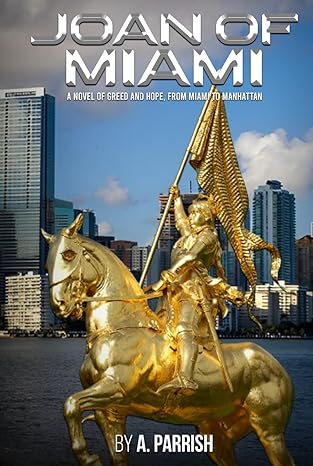
It’s an ambitious book and, to its credit, entertaining while committed to the radical notion that a young woman with opinions might actually change the world.
Read any good books lately? Let me know in the comments!
 Pickadilly Project